Why Not Compromise?

In politics, there’s a commonly held belief that politicians should moderate their beliefs and try to match what the average person believes in order to get elected. In fact, there’s a term for this: Median Voter Theorem.
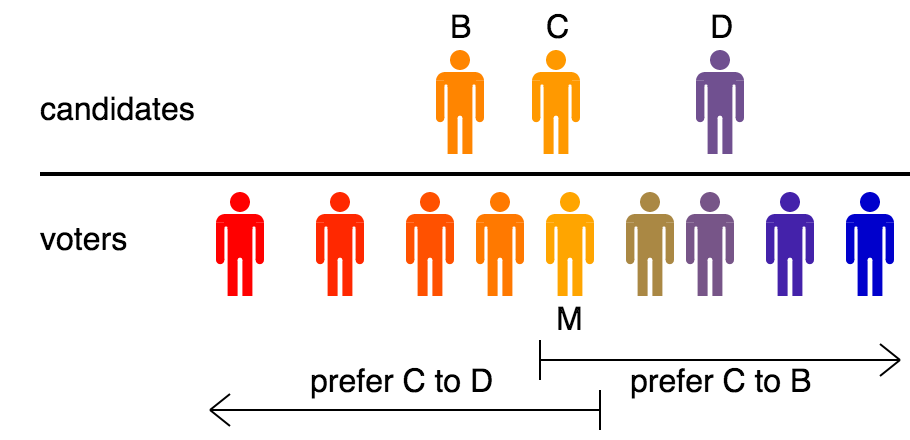
There’s a good bit of common sense here. If you’re an extremist that doesn’t even remotely represent the beliefs of the average voter, the average voter isn’t going to have much reason to vote for you. Compromising with your political opponents and adopting some of their beliefs will undoubtedly make you more appealing to some voters. Yet, I think this misses something. In this article, I want to be a bit contrarian and argue that excessive moderating is actually bad and that good politicians should have some controversial ideas.
Why Do We Run For Office?
Unless you live in a monarchy and end up inheriting the throne, you don’t just end up in office. Instead, you have to go out of your way to end up in a position of power. If you’re spending years or decades working for a political party, campaigning during election seasons, and engaging with your constituency, it’s worth wondering why exactly you’re working so hard to be a politician. Reasons may vary, but for most politicians, it’s because they have a vision that they want to see enacted. Politics isn’t about voting and writing laws, it’s about the power to shape the world around you. In democracies such as our own, power is bestowed onto politicians by the electorate, and the politicians have to regularly appeal to the electorate on why they should be given power with every election. If you have an opinion or belief that the electorate simply won’t tolerate, then yeah, you’ll have to drop it. However, if you go too far and base every opinion you have based on how it polls, you’ll come across as insincere and pandering. You have to believe things to appeal to the average voters.
If you have a vision for the country/province/city that voters aren’t sure about, it makes a lot more sense to try and convince them than to sheepishly back off whenever you’re criticized. As a politician, you should be a cheerleader for your beliefs. If you just can’t convince the electorate that a particular belief is good, at least see if the rest of your beliefs are popular enough to get elected. If you give up a belief without needing to, you compromised on your vision for the future for no reason. Voters may not like it when you fight for your most unpopular beliefs, but at least it shows that you have consistent opinions. If you shamelessly change your beliefs at the drop of a hat whenever you think that it would appeal to voters, you show yourself to be an opportunist who’s more concerned with personal gain than making a real difference.
Who Even Knows What The Median Voter Wants?
There’s a wide variety of beliefs that a voter could plausibly have, but that doesn’t mean that they can have all of them. Suppose 70% of voters support policy A and 60% support an unrelated policy called B. At first glance, it might seem like the best way to appeal to voters is to endorse both policies. However, this ignores conditional probability. If support for the two policies are negatively correlated, it’s possible that only 30% of voters actually support both policies. You need to go beyond basic polling to actually know what the median voter believes, but minor politicians don’t have the resources to do that. If you’re constrained on resources, it’s much better to just focus on what you believe instead of chasing unreliable polls.
Besides, very few people vote solely based on policies. Usually, at least some of it is going to be based on the candidate’s personality. At its most extreme, this manifests as cults of personality where people merely project their preferred policies onto a politician, even if the politician clearly doesn’t even endorse those policies. More typically, it just involves showing voters that you legitimately care and want to do a good job for your constituency. Frankly, most people don’t even really have that many deeply held beliefs about politics. If you simply show sincerity and advocate for your policies, you have a massive leg-up over somebody who just boringly recites a list of popular political positions.
Compromise In Parliament, Not During Elections
When it comes to seeing how compromise should be done, it’s hard to think of a better example than the Bloc Québécois. In elections, they’re completely uncompromising. They know that their platform of Quebec nationalism won’t win them any votes outside of Quebec, so they don’t even try. Instead of actually attempting to win the election, the Bloc just attempts to disrupt the balance of power enough that they have leverage over whatever party happens to win. This is a bit difficult in political systems that use first-past-the-post, but in political systems that use proportional representation, it’s a lot more realistic for parties to gain power with platforms that are broadly unpopular. While they never gain enough seats to rule on their own, they have the clout needed to form coalitions and demand concessions, provided that they compromise on other policies. In this sense, having unpopular policies is actually a benefit, since you can use those for leverage while pressing on the policies that voters care most about. If your genius goal is make real change in your community, running on a maximalist platform and compromising in parliament makes a lot more sense than pre-emptively backing down from unpopular policies and losing leverage after getting elected.
Conclusion
I’m not saying that compromise is always bad when you’re trying to get elected. Sometimes, it really is the best way to get votes. However, you also have to be careful that you aren’t leaving political capital on the table or coming off as insincere to the electorate.